


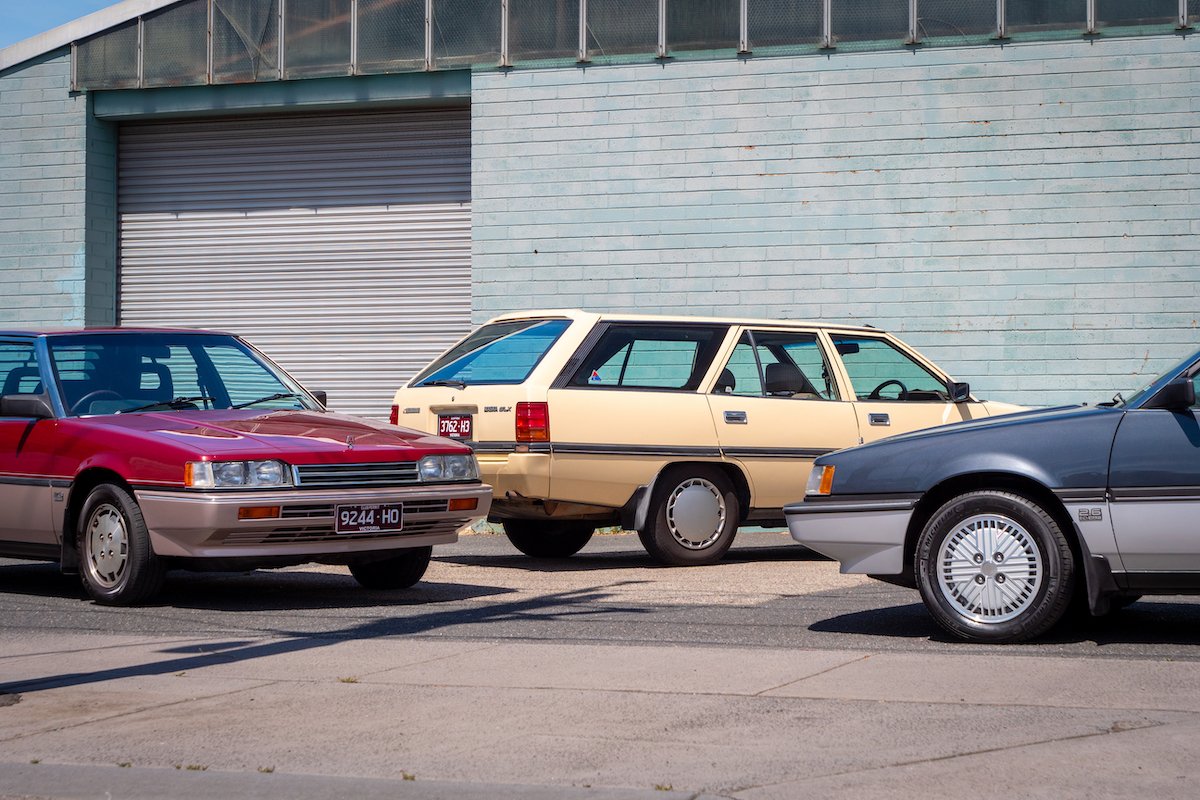
A family tourer, a first car, a car for retirement, the Mitsubishi Magna fit into all these stages of life perfectly and proved a reliable nameplate for more than 20 years in Australia, while opening up an import market for the Japanese marque’s local arm.
Replacing the Sigma in 1985, the Mitsubishi Magna was based on Japanese-sourced Galant platforms specially engineered for Australian conditions at a cost of $50 million.
The first TM generation Magna was manufactured at the Tonsley Park plant starting in April 1985, with the challenger to Commodore and Falcon being front-wheel-drive just like the Galant it was based. It was Australianised courtesy of a wider body compared to its Japanese contemporary and strengthened to meet the unique local conditions.
Smaller and lighter compared to its Australian rivals, the Magna was superior in many ways compared to its rivals including interior space, fuel economy courtesy of the four-cylinder, 2.6-litre Astron II engine, which also reduced vibrations courtesy of hydraulic mounts although the unit was carbureted.
A five-speed manual and four-speed automatic were available with certain specification levels, but the high-end Elite offering only came in the latter, as did the Executive.
Suspension was MacPherson strut at the front and three-link torsion beam at the rear.
Mitsubishi won Wheels Car of the Year in 1985 with the Magna, which made it back-to-back for the manufacturer after the Nimbus took out the 1984 award.
The first Magna was not immune to problems as fragile engine heads and automatic transmissions continued to be rectified until the release of the TN in 1987.
The introduction of the TN also welcomed a wagon to the line-up for the first time among other updates to the appearance, the addition of electronic fuel injection, increased equipment and improved audio package continued the strong sales leading to 209,000 Magnas being produced during these two generations.
A further update came in the TP for 1989 bringing an improved automatic transmission, power steering being standard and a special Grand Tourer limited edition in two runs featuring a bodykit among other sporty additions.
The first major change to the Magna came in 1991 through the TR/KR generation using the already wide-body Japanese Mitsubishi Sigma, but development costs rose to $389 million until the wagon was released in 1992.
An aerodynamically efficient design was a dramatic change compared to the first generation Magnas.
Still using the Astron II, the Cyclone 3.0-litre V6 was introduced for the top specification Verada and this led to exportation. The Verada was exported in Japan, the US, UK and New Zealand where 40,000 units per year sold at its height under the Diamante and Sigma brands.
Anti-lock brakes and driver’s airbag were introduced in the Verada before the next generation was introduced in 1994.
TS/KS was a minor update and the V6 engine was an option on all specification levels as this generation marked a step up to a more premium level perfectly leading into the next model era.
Winning the second Wheels Car of the Year award for Magna was the TE/KE range in 1996, which was based on the Japanese Diamante, but again the body was bigger, stiffer and was less than 20kgs heavier.
Increased interior space was welcomed, but a high waist line led to complaints of being claustrophobic as the pillar less doors gave a sporty appearance.
A much more squared exterior was mated with a superb 2.4-litre four-cylinder Sirius engine and the continuation of the Cyclone V6 making for a strong offering.
Braking and suspension areas were improved dramatically, while the INVECS II provided a major advancement compared to the previous generation.
Exports continued to globally except Japan as the US was its biggest market across 18 countries reaching 25,000 units a year.
The KF/TF was released in 1997 and featured limited improvements before the TH/KH came in 1999.
It was during this generation the four-cylinder was dropped due to consumers after more powerful options leading to the V6 being widely offered across the range.
With the arrival of the TJ/KJ versions in 2000, the Magna Sports and VR-X performance versions were introduced leading to the Ralliart concept, turned showroom offering. Although watered down due to budget constraints compared to the concept, the Ralliart still featured enough options to make it a special version.
All-wheel-drive also entered the line-up during the TJ/KJ Series 2 run leading to a controversial commercial deemed to display dangerous driving and Mitsubishi was then forced to change.
Closing out a 20-year history was the TL/KL Magna featuring controversial styling and was again mild update introduced during 2003.
Magna sales had slowed starting from 2000 and Mitsubishi had plans for a fresh new model to take over the mantle for 2005 named the 380, however this failed to stop its pull out of Australian manufacturing in 2008.
Just like many manufacturers now, Mitsubishi is solely an importer and its line-up consists of just SUVs and Utes having stopped producing the Lancer in 2017 (Taiwan exclusively in 2024).